Carbon
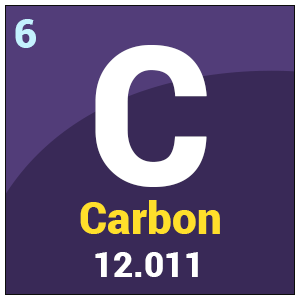
| Symbol | C |
| Atomic Number | 6 |
| Atomic Mass | 12.011 |
| Discovered | Lavoisier proposed carbon in 1789 |
The Atomic number of Carbon is 6.
Chemical Properties of Carbon
| Group | 14 | Melting point | Sublimes at 3825°C, 6917°F, 4098 K |
| Period | 2 | Boiling point | Sublimes at 3825°C, 6917°F, 4098 K |
| Block | p | Density (g cm−3) | 3.513 (diamond); 2.2 (graphite) |
| Atomic number | 6 | Relative atomic mass | 12.011 |
| State at 20°C | Solid | Key isotopes | 294Ts |
| Electron configuration | [He]2s2 2p2 | CAS number | 87658-56-8 |
| ChemSpider ID | – | ChemSpider is a free chemical structure |
What is Carbon?
- Carbon compounds are present everywhere i.e. in the food that we eat, the clothes that we wear and even in the lead of the pencil by which we write.
- The atomic number of carbon is 6 and the atomic mass is 12.01gmol-1.
- Represented by the symbol C and present in the 14th group of elements in the Periodic Table.
- According to the data, it is the seventeenth most abundant element found on earth.
- It is found in both free and in the combined state. You can find it available as coal, graphite in the elemental state. Whereas it is present as metal carbonates, hydrocarbons, and carbon dioxide gas in the combined state. When it combines with other elements such as dihydrogen, dioxygen, chlorine, and sulphur provides amazing arrays of materials that can vary from tissues to medicines.
The carbon allotropes include graphite, one of the softest substances known, and diamond, the hardest material that exists naturally. It easily bonds with other small atoms, including other carbon atoms, and can form several stable covalent bonds with acceptable multivalent atoms. Almost ten million compounds, a vast majority of all chemical compounds, are known to form carbon. Of all elements, carbon also has the highest sublimation point. It has no melting point at atmospheric pressure.
Carbon compounds form the basis of all known life on Earth and some of the energy produced by the Sun and other stars is generated by the carbon-nitrogen cycle. While it forms an exceptional variety of compounds, under normal conditions, most forms of carbon are comparatively unreactive. It resists all but the strongest oxidizers at normal temperature and pressure. Sulfuric acid, hydrochloric acid, chlorine or any alkali do not react. Carbon reacts with oxygen to form carbon oxides at elevated temperatures and can steal oxygen from metal oxides to leave only the elemental metal.
Uses of Carbon
- One of the most amazing properties of carbon is its ability to make long carbon chains and rings. This property of carbon is known as catenation.
- Carbon has many special abilities out of all one unique ability is that carbon forms pπ-pπ bonds which are nothing but double or triple bonds with itself and with other electronegative atoms like oxygen and nitrogen.
- Just because of these two properties of carbon i.e catenation and multiple bond formation, it has a number of allotropic forms.
Leave a Reply