Sodium
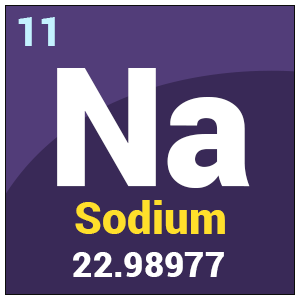
| Symbol | Na |
| Atomic Number | 11 |
| Atomic Mass | 22.990 |
| Discovered by | Sodium was discovered by Humphry Davy |
Physical Properties of Sodium
- Sodium has a strong metallic lustre and in colour is very analogous to silver.
- It is soft at common temperatures that it may be formed into leaves by the pressure of the fingers.
- Sodium compounds soon tarnish on exposure to the air, though less rapidly than potassium.
- Sodium is instantly oxidized by water, hydrogen gas in temporary union with a little sodium being disengaged.
Chemical Properties of Sodium
| Group | 1 | Melting point | 97.794°C, 208.029°F, 370.944 K |
| Period | 3 | Boiling point | 882.940°C, 1621.292°F, 1156.090 K |
| Block | s | Density (g cm−3) | 0.97 |
| Atomic number | 11 | Relative atomic mass | 22.990 |
| State at 20°C | Gas | Key isotopes | 23Na |
| Electron configuration | [Ne] 3s1 | CAS number | 7440-23-5 |
| ChemSpider ID | 4514534 | ChemSpider is a free chemical structure database |
What is Sodium?
- Sodium is a member of the alkali metal family with lithium and potassium. Being one of the two elements in our table salt is its the biggest claim to fame.
- We get sodium chloride (NaCl) when sodium bonds with chlorine (Cl). It is also used as a salt in fertilizers.
- Sodium is reactive, soft metal with a low melting point and most important of all the alkaline metals from the commercial point of view. Sodium reacts rapidly with water, snow, and ice to produce sodium hydroxide.
- When metallic sodium is exposed to air, it loses its silver appearance and develops an opaque grey colour layer which is a coating of sodium oxide. Sodium does not react with nitrogen even at very high temperatures but reacts with ammonia to form sodium amide.
- Sodium reacts with hydrogen above 200ºC to form sodium hydride. It also reacts with various metallic halides to form sodium chloride and the metal.
- With an atomic number of 11, it is represented by the symbol Na in the Periodic table.
Uses of Sodium
- It also used in improving the structure of certain alloys; soaps, purification of molten metals and in sodium vapour lamps.
- Sodium is a component of sodium chloride, which is a very important compound found in the living environment.
- Sodium is important in the manufacturing of organic compounds and in making esters.
- Solid sodium carbonate is required in making glass.
Leave a Reply