Argon
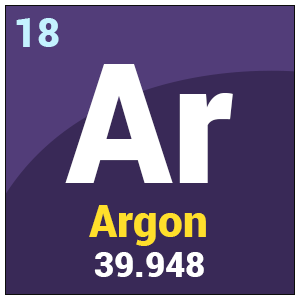
| Symbol | Ar |
| Atomic Number | 18 |
| Atomic Mass | 39.948 g.mol-1 |
| Discovered by | Sir Ramsay in 1894 |
Table of Contents
- What is Argon?
- Properties Of Argon
- Chemical Properties Of Argon
- Uses Of Argon
- Certain Facts About Argon
- Frequently Asked Questions – FAQs
What is Argon?
Argon is a chemical element in the eighteen group of the periodic table. It is a noble gas, and it is the third most abundant gas in earth’s atmosphere.
Argon is the most common gas in the atmosphere besides Nitrogen and Oxygen. Argon is a noble gas (like helium) which means that it is completely inert.
Properties Of Argon
- It is odourless, colourless gas that is totally inert into other substance.
- Under extreme conditions, argon can form certain compounds even though it is a gas.
- It is characterized by same solubility level in water as that of oxygen.
- It has low thermal conductivity.
Chemical Properties Of Argon
| Group | 18 | Melting point | -189 oc |
| Period | 3 | Boiling point | -185.7 oc |
| Block | p | Density (g cm−3) | 0.001633 |
| Atomic number | 18 | Relative atomic mass | 39.948 |
| State at 20°C | Gas | Key isotopes | 40Ar |
| Electron configuration | [Ne] 3s23p6 | CAS number | 7440-37-1 |
| ChemSpider ID | 22407 | ChemSpider is a free chemical structure database |
Uses Of Argon
- They are used in metal industries.
- It is used in the production of titanium.
- It is used in double dazzled windows to fill the space between the panels.
Certain Facts About Argon
- Argon was suspected to be present in air by Henry Cavendish in the year 1785.
- According to Chimcool, the majority of argon is the isotope argon-40 which emerge from radioactive
Leave a Reply