Apart from discovering the cause of the fall of an apple from a tree, that is, the laws of gravity, Sir Isaac Newton was perhaps one of the most brilliant and greatest physicists of all time. He shaped dramatic and surprising discoveries in the laws of physics that we believe our universe obeys, and hence it changed the way we appreciate and relate to the world around us.
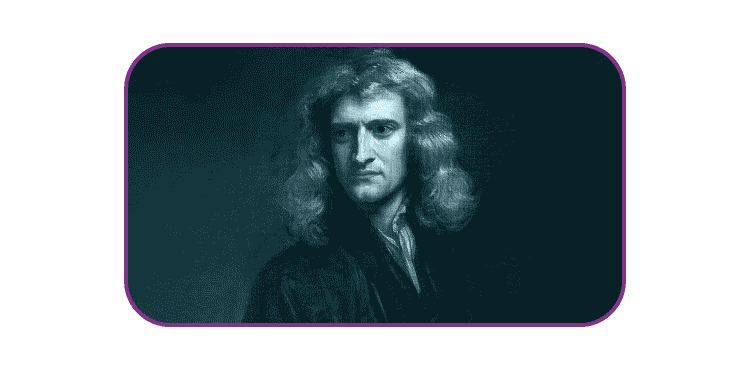
About Sir Isaac Newton
Sir Isaac Newton was born on 4th January 1643 in a small village of England called Woolsthorpe-by-Colsterworth. He was an English physicist and mathematician, and one of the important thinkers in the Scientific Revolution.
He discovered the phenomenon of white light integrated with colours which further laid the foundation of modern physical optics. His famous three laws of Motion in mechanics and the formulation of the laws of gravitation completely changed the track of physics across the globe. He was the originator of calculus in mathematics. A scientist like him is considered an excellent gift by nature to the world of physics.
Sir Isaac Newton’s Education, Awards and Achievements
Isaac Newton studied in the Trinity College, Cambridge, in 1661. At 22 in 1665, a year after beginning his four-year scholarship, Newton finished his first significant discovery in mathematics, where he revealed the generalized binomial theorem. He was bestowed with his B.A. degree in the same year.
Isaac Newton held numerous positions throughout his life. In 1671, he was invited to join the Royal Society of London after developing a new and enhanced version of the reflecting telescope.
He was later elected President of the Royal Society (1703). Sir Isaac Newton ran for a seat in Parliament in 1689. He won the election and became a Member of Parliament for Cambridge University. He was also appointed as a Warden of the Mint in 1969. Due to his exemplary work and dedication to the mint, he was chosen Master of the Mint in 1700. After being knighted in 1705, he was known as “Sir Isaac Newton.”
Some Achievements of Isaac Newton in Brief
His mind was ablaze with original ideas. He made significant progress in three distinct fields – with some of the most profound discoveries in:
- Calculus, the mathematics of change, which is vital to our understanding of the world around us
- Gravity
- Optics and the behaviour of light
- He also built the first working reflecting telescope
- He showed that Kepler’s laws of planetary Motion are exceptional cases of Newton’s universal gravitation.
Sir Isaac Newton’s Contribution in Calculus
Sir Isaac Newton was the first individual to develop calculus. Modern physics and physical chemistry are almost impossible without calculus, as it is the mathematics of change.
The idea of differentiating calculus into differential calculus, integral calculus and differential equations came from Newton’s fertile mind. Today, most mathematicians give equal credit to Newton and Leibniz for calculus’s discovery.
Law of Universal Gravitation
The famous apple that he saw falling from a tree led him to discover the force of gravitation and its laws. Ultimately, he realized that the pressure causing the apple’s fall is responsible for the moon to orbit the earth, as well as comets and other planets to revolve around the sun. The force can be felt throughout the universe. Hence, Newton called it the Universal Law of Gravitation.
Newton discovered the equation that allows us to compute the force of gravity between two objects.
Newton’s Laws of Motion
- First law of Motion
- Second Law of Motion
- Third law of Motion
Leave a Reply