Flutter gives easy and simple methods to start building beautiful mobile and desktop apps with a rich set of material design and widgets. Here, we are going to discuss its main features for developing the mobile framework.
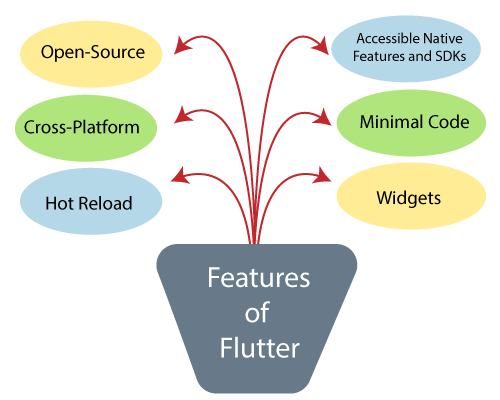
Open-Source: Flutter is a free and open-source framework for developing mobile applications.
Cross-platform: This feature allows Flutter to write the code once, maintain, and can run on different platforms. It saves the time, effort, and money of the developers.
Hot Reload: Whenever the developer makes changes in the code, then these changes can be seen instantaneously with Hot Reload. It means the changes immediately visible in the app itself. It is a very handy feature, which allows the developer to fix the bugs instantly.
Accessible Native Features and SDKs: This feature allows the app development process easy and delightful through Flutter’s native code, third-party integration, and platform APIs. Thus, we can easily access the SDKs on both platforms.
Minimal code: Flutter app is developed by Dart programming language, which uses JIT and AOT compilation to improve the overall start-up time, functioning and accelerates the performance. JIT enhances the development system and refreshes the UI without putting extra effort into building a new one.
Widgets: The Flutter framework offers widgets, which are capable of developing customizable specific designs. Most importantly, Flutter has two sets of widgets: Material Design and Cupertino widgets that help to provide a glitch-free experience on all platforms.
Leave a Reply