Magnesium
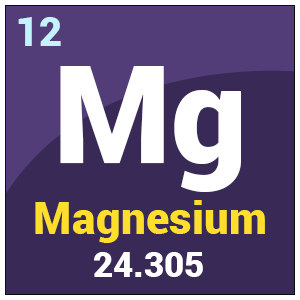
| Symbol | Mg |
| Atomic Number | 12 |
| Atomic Mass | 24.305 |
| Discovered by | Magnesium was discovered by Joseph Black |
Chemical Properties of Magnesium
| Group | 2 | Melting point | 650°C, 1202°F, 923 K |
| Period | 3 | Boiling point | 1090°C, 1994°F, 1363 K |
| Block | s | Density (g cm−3) | 1.74 |
| Atomic number | 12 | Relative atomic mass | 24.305 |
| State at 20°C | Gas | Key isotopes | 24Mg |
| Electron configuration | [Ne] 3s2 | CAS number | 7439-95-4 |
| ChemSpider ID | 4575328 | ChemSpider is a free chemical structure database |
What is Magnesium?
- Magnesium is the most chemically active element. In boiling water, the place of hydrogen is taken by Magnesium and a number of metals can be produced using thermal reduction of its salts and oxidized forms with magnesium. We find Magnesium in the second position in the periodic table. We have been using Magnesium since a hundred years, in bonded form. It was only when a Chemist, Sir Humphry Davy purified and isolated the metal. Since it was found in the bonded form in nature, Magnesium took so long to isolate.
- Magnesium is labelled as the eighth most abundant element and about 2% of earth’s crust is constituted by Magnesium. In seawater, it is the most plentiful element present. It is not only found in seawater but also in underground brines and salty layers. After aluminium and iron, magnesium is the third most abundant structural metal in the earth’s crust.
Uses of Magnesium
- Magnesium is used by a scientist in medicine. It is used to treat widely in skin related problems and attention deficit-hyperactivity disorder (ADHD), anxiety, mania, recovery after surgery etc.
- The green leafy vegetable is an excellent source of Magnesium. Whole grain, seeds, and nuts (Mainly almonds) are also a great source of Magnesium.
- The flashbulbs also contain Magnesium. When Mg burns, it produces a bright light that helps the photographers to take photos in the dark.
Leave a Reply